Logic Grid Puzzles: Brain Game
- 4.7
- Rating
- 100.00K
- Installs
- Free
- Price

 Analysis by App-foxy
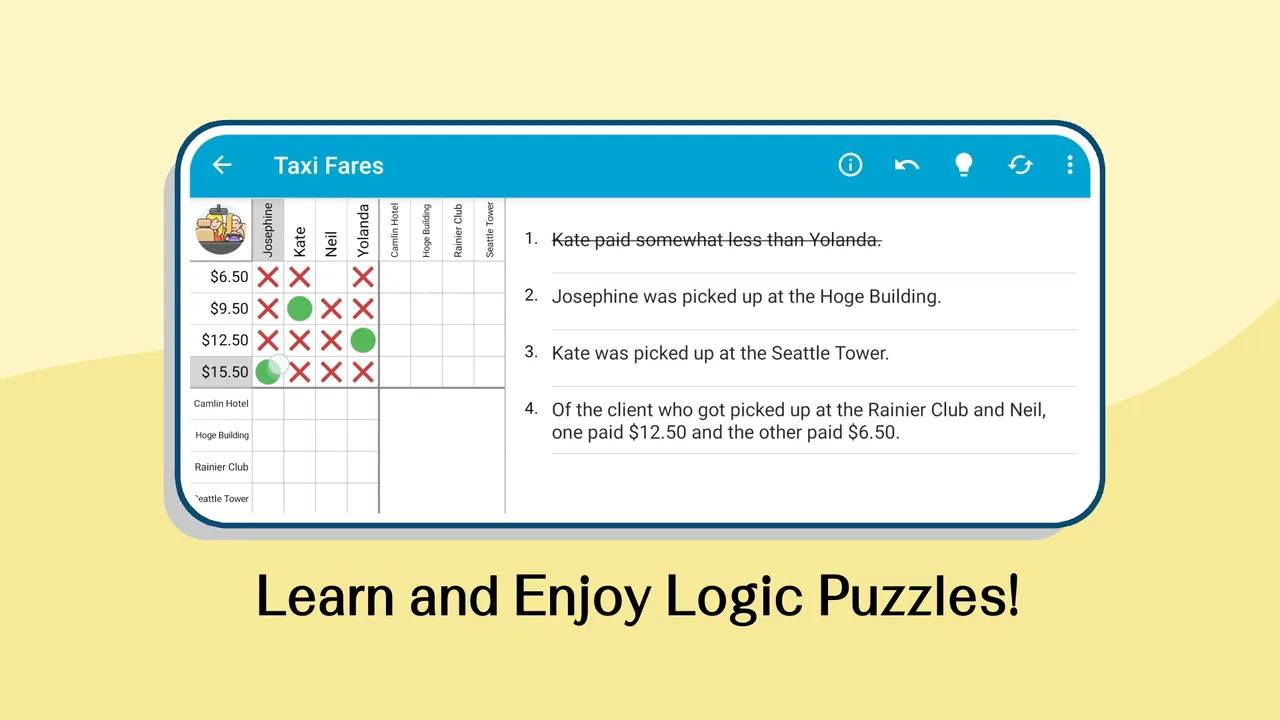
I like word games that make me slow down rather than simply react quickly, and Logic Grid Puzzles: Brain Game fits that preference well. It is a deduction game from Egghead Games LLC built around the familiar logic-grid format: read a set of clues, connect people, places, objects, or other categories, and eliminate impossible combinations until one answer remains. The appeal is not speed or flashy presentation. It is the small satisfaction of turning a messy paragraph of clues into a clean, defensible solution.
After spending time with it, I see this as a focused choice for players who enjoy structured thinking in short sessions. It is free to start, rated for Everyone, and available for devices running Android 6.0 or later. Its current version is 5.5.1, and the game has built a solid audience, with a 4.7 average from around 2.3 thousand ratings and more than 100 thousand installs. Those figures suggest that the format is connecting with the right audience, although they do not change the central question: whether you personally enjoy careful deduction enough to return to it.
How the puzzle experience works in practice
The basic rhythm is straightforward. I first read the clues, identify the relationships they describe, and then use the grid to mark what can or cannot be true. A clue might directly place one item with another, while a different clue may only become useful after several earlier possibilities have been removed. The best moments come from those indirect deductions, when a clue that seemed vague suddenly becomes decisive because the rest of the grid has narrowed.
You May Also Like

 Blood Strike: 2.5 Anniversary
Blood Strike’s Loadouts Turn Every Drop Into a Tactical Gamble
A close look at Blood Strike’s custom loadouts: how fast access to signature weapons reshapes its battle royale rhythm, rewards preparation, and narrows the gap between fights.

 Pandora - Music & Podcasts
Pandora’s Music Is Easy to Start, but Harder to Recover
Pandora’s strength is its low-effort path from a seed to a station. Its weak spot is how much confidence it asks you to place in connection, setup, and quiet recovery.

 8 Ball Pool
 Is Built on Rivalries, Rematches, and Routine
A close look at the rivalries, rematches, shared routines, and unanswered safety questions that turn a quick pool match into a persistent mobile community.

 Samsung Music
’s Quiet Strength Is Playing What You Already Own
Its reach comes less from spectacle than from dependable access to a personal library. That simplicity is both the app’s strongest retention engine and its ceiling.

 AccuWeather: Weather Radar
AccuWeather Review: A Quick, Clear Forecast for Everyday Decisions
For everyday plans, the best forecast is the one you can understand quickly. AccuWeather makes rain timing, radar, and local conditions easy to act on, with a few trade-offs.

 Hill Climb Racing
Why Hill Climb Racing Still Turns Crashes Into One More Run
A tiny car, a bumpy hill and one more upgrade: Hill Climb Racing keeps resurfacing because its simple chaos makes every near-miss feel personal.
More From Our News Desk
View All News


This makes the game different from a conventional word search, an anagram app, or a crossword. Those formats often reward vocabulary, spelling, or quick recognition. Here, vocabulary still matters because I need to understand the wording, but the main skill is keeping several possibilities organized without jumping to conclusions. The grid acts as an external memory, which is especially useful when a puzzle contains more relationships than I could comfortably track in my head.
I also appreciate that the game’s central mechanic encourages a disciplined workflow. Instead of guessing an answer because it feels likely, I can record a confirmed match, cross out contradictions, and wait for the remaining clues to do the work. That habit is valuable beyond the game. It trains me to separate a fact from an assumption, something many puzzle apps claim to do but do not make as visible.
A practical way to approach a new puzzle is to begin with the most definite clues. Direct statements are usually more useful than clues involving order, comparison, or exclusion. I mark those first, then scan each row and column for a point where only one option remains. This is more reliable than reading all the clues repeatedly and trying to remember them. The game rewards methodical play, so treating the grid like a small investigation produces better results than rushing.
One less obvious strength is that the grid turns mistakes into information. If I place a relationship that later conflicts with several clues, I can trace the contradiction back through the marks rather than feeling that the entire puzzle has collapsed. That makes the learning curve gentler than it may appear at first. I gradually become better at spotting which clues carry the most weight and which ones should be saved for later.
Why the format works for short breaks
Logic Grid Puzzles: Brain Game suits moments when I want something more absorbing than casual tapping but do not have time for a long game. A single puzzle can be approached in stages: I can read the clues during a quiet break, fill in the obvious relationships later, and return when I have enough attention to finish the deduction. That flexibility is important because logic puzzles become frustrating when I try to solve them while distracted.
A realistic everyday use would be a commute or a waiting-room visit. I can open a puzzle, establish the strongest facts, and stop before making careless guesses. When I return, the marked grid gives me a visible starting point. It is a better fit for interrupted attention than a timed word challenge, where leaving halfway through may cost progress or break the rhythm of the round.
There is also a useful distinction between relaxing and effortless. This game can feel calming because the rules are contained and the objective is clear, but it still demands concentration. If I am tired and only want a passive distraction, a simple word search or an endless arcade game is probably a better choice. The mental effort is the product here, not an inconvenience around it.
Getting more from the clue structure
My most effective technique is to divide clues into three groups: direct matches, exclusions, and clues that depend on order or comparison. I handle the direct matches first, use exclusions to reduce the remaining choices, and leave the more complicated wording until the grid has enough context. This prevents one difficult sentence from controlling the entire session.
Another useful habit is to avoid treating every empty square as equally important. Some empty spaces are merely possibilities, while others are the last open position in a row or column and therefore carry much more information. I look for those nearly completed lines before rereading the full clue list. This often reveals a deduction that was already available but easy to miss.
I also recommend checking a conclusion against all relevant clues before committing to it mentally. In a logic-grid puzzle, a solution can appear convincing because it satisfies one or two statements while quietly breaking another. The grid is most helpful when I use it to verify a chain of reasoning, not just to record the answer I want to be true. That extra check takes little time and prevents the common frustration of building an entire solution on one premature assumption.
For players who use these games as brain training, the benefit is more specific than a broad promise of improved intelligence. The activity exercises attention, comparison, working memory, and logical elimination. I would describe it as a structured mental workout rather than a complete training program. It is most useful when played consistently and thoughtfully, not when I rush through puzzles simply to increase a completion count.
Cost, free access, and the question of value
The game is free to download and play, which makes trying the format easy. That matters because logic-grid puzzles are a preference-based genre. Some people enjoy the feeling of proving an answer; others find the process too slow or restrictive. Free access lets me discover which group I belong to before spending anything.
There are in-app purchases priced from $2.99 to $4.99 per item. I view those purchases as an optional value decision rather than part of the basic reason to install the game. The free entry point is useful for sampling the experience, while the paid items may make sense for someone who already knows that this particular puzzle style will become a regular habit. I would not buy automatically on the first session; I would first check whether I enjoy solving several puzzles without feeling that the grid becomes repetitive.
The important trade-off is between free access and deeper personal value. A free game is not automatically valuable if I open it once and abandon it. Conversely, a small optional purchase can be worthwhile if it supports a hobby I return to during commutes, evenings, or quiet weekends. Since the available purchase range is clear but the personal usefulness depends on playing habits, my advice is to judge the cost against expected use rather than against the price of other mobile games.
That approach also helps avoid a common mistake with puzzle apps: paying because the first challenge was satisfying, then discovering that the format is not something I want every day. I would install it, solve enough to understand the difficulty and wording, and only then decide whether any paid item adds enough value for my routine. The free starting point makes that cautious approach practical.
Where it stands beside familiar alternatives
Compared with crosswords, this game asks less of my general vocabulary and more of my ability to organize relationships. A crossword can reward knowing an obscure word or recognizing a familiar phrase, whereas a logic grid can remain approachable even when the subject matter is ordinary, provided I read the clues carefully. Players who dislike trivia may find that difference refreshing.
Compared with word searches, the experience is much less automatic. A word search gives me a visual scanning task with a clear pattern, while this game requires a sequence of deductions. That makes it more satisfying for deliberate thinkers but less suitable when I want something almost meditative. The choice depends on whether I want to discover hidden letters or prove a set of connected facts.
Compared with sudoku, the two games share a love of elimination but create different kinds of pressure. Sudoku is built around numerical patterns and repeated grid structures. Logic Grid Puzzles: Brain Game adds language, interpretation, and relationships between categories. I prefer this title when I want the clues themselves to tell a small story, but sudoku may be better for someone who wants a more abstract challenge with fewer words to parse.
It also differs from trivia games in an important way: success does not depend on already knowing the answer. The information needed is contained in the clues, so the challenge is how well I combine those facts. That gives the game a fairer feeling for me than quizzes based on specialist knowledge. However, the wording still needs careful reading, so anyone who dislikes verbal puzzles may be happier with a purely visual or numerical alternative.
Small frictions that affect the experience
The same structure that makes the game satisfying can also make it demanding. A single misunderstood clue may send me down the wrong path, especially if I assume that a statement means more than it actually says. I have learned to slow down and reread the exact relationship instead of filling the grid according to what seems natural. That is a reasonable challenge, but it can feel like friction when I am playing while tired.
The format may also feel repetitive to players who need constant novelty in mechanics. The core activity remains reading, marking, eliminating, and confirming. For me, variation in the clues can sustain that loop, but someone looking for character progression, action, social competition, or a strong narrative should skip this game. It is intentionally narrow in focus.
Another limitation is that the game does not replace a notebook for every kind of thinker. I like having the grid directly connected to the clues, but some players prefer writing out their own diagrams or using a larger screen to see every relationship at once. On a phone, the compact format is convenient, yet it can require more deliberate scanning than a printed puzzle. I would especially consider a larger display if small text or dense grids usually tire my eyes.
The age rating is Everyone, which makes the game broadly suitable for family use. Still, suitability in practice depends less on content than on patience. A younger player may understand the clues but become discouraged if they expect instant answers. I would introduce it as a shared deduction activity rather than a speed contest, with an adult helping explain how to record possibilities without giving away the solution.
Who will get the most from it
I recommend it most strongly to people who enjoy nonograms, sudoku, crosswords, or detective-style reasoning but want a puzzle based on written clues. It is also a good choice for anyone trying to replace idle scrolling with a more active break. The game gives me a concrete task, a visible record of progress, and a clear point at which the reasoning is complete.
It can work well for students and lifelong learners who want to practice careful reading. I would not present it as a substitute for formal study, but it does encourage habits that are useful when dealing with lists, conditions, and linked information. The strongest benefit comes when I explain my reasoning to myself instead of tapping marks mechanically.
It is less suitable for players who want immediate rewards, rapid rounds, or a constant stream of visual stimulation. If your ideal mobile game involves unlocking characters, competing on a leaderboard, or reacting under time pressure, this will probably feel quiet and slow. Likewise, if you regularly abandon puzzles as soon as one clue becomes difficult, the format may test your patience more than your vocabulary.
For households, the game can become a cooperative activity. Two people can read the clues together, propose deductions, and challenge each other’s assumptions. That works especially well when neither player rushes to announce the answer. The grid provides a neutral place to test an idea, so disagreement becomes part of the reasoning rather than an argument about who remembers a fact correctly.
My recommendation after weighing the trade-offs
The strongest reason to try it is that the free entry point lets you test a genuinely thoughtful puzzle format without committing first. I like the way the game turns language into a structured investigation, and I find the grid more rewarding than many quick word-game loops. The 4.7 average and broad install base are encouraging signs, but my recommendation rests more on the quality of the deduction experience than on popularity.
I would download it if I wanted a calm, focused word game for short sessions, especially if I already enjoy sudoku or crosswords but want something less dependent on vocabulary knowledge. I would spend on an in-app item only after confirming that I return to the puzzles regularly. The purchase range of $2.99 to $4.99 per item is easier to justify as part of a recurring hobby than as an impulse buy after one enjoyable challenge.
I would skip it if I need action, social competition, or a constantly changing set of mechanics. I would also choose a conventional crossword when I specifically want clues that test word knowledge, or sudoku when I prefer purely numerical logic. Those are not failures of this game; they are signs that each puzzle type serves a different mood.
Overall, Logic Grid Puzzles: Brain Game is a focused and worthwhile free word game for patient thinkers. Egghead Games LLC has centered the experience on the part that matters most: turning clues into deductions and allowing the player to feel the solution emerge. It will not suit everyone, but for me it earns a recommendation as a practical brain-training pastime, a good waiting-room companion, and a sensible first step into logic-grid puzzles without an upfront price.
FAQs for Logic Grid Puzzles: Brain Game
01What is Logic Grid Puzzles: Brain Game?
Logic Grid Puzzles: Brain Game is a challenging app designed to enhance your problem-solving skills through a series of logic puzzles. Each puzzle requires you to deduce the correct answers by using clues provided. The game is suitable for all ages and provides a fun way to exercise your brain.
02How does the game improve cognitive skills?
The game enhances cognitive skills by engaging players in critical thinking and problem-solving. It requires attention to detail, pattern recognition, and logical reasoning. Regular play can help improve memory, concentration, and analytical skills, making it an excellent choice for anyone looking to sharpen their mind.
03Is the app free to download and play?
Logic Grid Puzzles: Brain Game is free to download on both Android and iOS platforms. While the basic version offers a variety of puzzles, there are in-app purchases available for users who wish to access additional content or remove ads. This allows players to enjoy a customizable gaming experience.
04What types of puzzles are included in the game?
The game features a wide range of logic puzzles, including classic grid puzzles, Sudoku-style challenges, and unique brain teasers. Each puzzle comes with a set of clues that players must use to deduce the correct answers. The variety ensures that players of all skill levels will find engaging content.
05Can I play the game offline?
Yes, Logic Grid Puzzles: Brain Game can be played offline once downloaded. This is ideal for users who want to enjoy the game without an internet connection. However, certain features, such as leaderboard updates and in-app purchases, may require an internet connection.
Pros
- Challenging puzzles enhance critical thinking.
- User-friendly interface with intuitive controls.
- Variety of puzzles keeps gameplay fresh.
- Offline mode available for on-the-go play.
- Regular updates with new puzzles.
Cons
- Ads can interrupt gameplay flow.
- Limited hints for difficult puzzles.
- Some puzzles may feel repetitive.
- In-app purchases can be pricey.
- No multiplayer or cooperative mode.

Logic Grid Puzzles: Brain Game
Gallery